
A postcard in the mailbox…
In December of 2024 we were chatting with our oldest son who lives in Toronto. He was renting an apartment in an older home, and had recently received a postcard in their mailbox. The card was from Health Canada, part of their annual November radon awareness campaign. The card recommended that all homes should be tested for radon gas.
Our son was moving out soon to another apartment, so after reading it, he decided he should pass the information on to his US landlord. The card explained that radon gas was found in homes all across Canada, often in unsafe concentrations, and was the #1 cause of lung cancer in non-smokers. Despite being 31 years old and highly educated, this was information about a health risk he had never really heard of before.
He brought it up during our next family chat with my husband and I and his sister. “Have you ever had the house tested for radon gas?” he wanted to know. No we had not. “Why not? It says radon is in every home in Canada.”
I had heard of radon gas. But to my knowledge, it wasn’t a problem that affected homes in PEI. It was something that was found in ‘other’ provinces…with different geology…igneous rock like granite. I reminded him how PEI’s famous red-brown soil is underlain by sedimentary sandstone and conglomerate bedrock. “I really don’t think it’s a problem here in PEI”, I said. “The card says its found in every home in Canada” my son restated. By this time, his sister (26 yrs. old and still living at home) was starting to chime in with concern that we had never tested for it.
We decide to test
“OK, well then I guess we can do a test for everyone’s peace of mind” I said. A quick internet search and we found that a test sensor could be ordered online from the NS PEI Lung Association for $55, which included lab testing.
My husband agreed to take responsibility for ordering it. Soon after it arrived, I read the test instructions which said to place the sensor in the lowest level of the home where someone spends a minimum of 4 hours per day. Our youngest son, 22 yrs old, had moved his bedroom to the basement several years ago and typically spent at least 16 to 20 hours per day in his room, much to our chagrin. So I hung it from the floor joists in the basement at breathing level, just outside his bedroom. It was January 28/25. It was the right time of year to start a radon test according to the various web sites.
The test instructions said we needed to leave the sensor in place for a minimum of 3 months and up to a maximum of 1 year. I was confident the test results would come back very low. So I thought, “I’ll let it run for a good long time so that if there are only trace levels of radon, the test will still pick them up.” I put it out of my mind for the rest of the winter, spring, summer and fall…
319 days later
Fast forward to December 2025… “I better check when I started that test” I thought. “I don’t want to go over the one year test time limit and have to start all over again!” The sensor was taken down on Dec. 13/25, which was 319 days after it was first hung from the ceiling. “That was a good long term test” I thought to myself.
A shipping envelope, conveniently pre-addressed to the lab was included with the test kit. Canada Post was on strike so I decided I would ship it using UPS to make sure the lab got it in time.
Results of our long term test are in
The lab emailed the results to my husband on Jan. 23/26. I had been asking him pretty regularly if he had received the results yet. He found their email on Jan. 26. He sent the results to me in a chat message. An image of the test report is shown below.
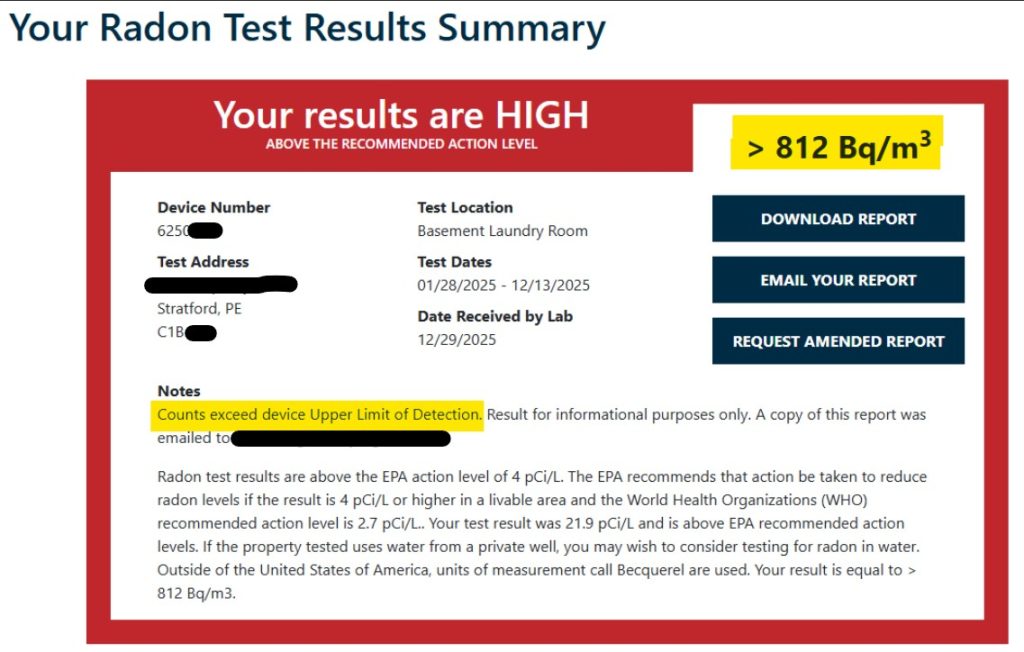
Alarmed, I messaged my husband back. “OMG!! It’s above the upper detection limit of the sensor!”
My husband thought we should retest. “Maybe its a bad test…it was running for a long time” he said.
“This testing device is supposed to be the ‘gold standard’ for accuracy” I said. “And the test instructions said a long term test provides a better indication of what the average levels are over the year.”
We didn’t want to wait another three months with everyone breathing in toxic air to find out how high the levels actually were. After some quick research my husband had two electronic radon detectors on order that are certified by Health Canada. They cost in the range of $180 to $250.
I had read from my research that radon levels are usually lower on upper levels of a home. That evening, our son moved out of the basement into a room on the main floor. All I could think of was how much radon has he been breathing in for the past 7+ years living in the basement? And before that, for him and the rest of us on the main floor and 2nd floor where the other bedrooms are? We built the house in 1999. I was pregnant with our daughter and she was born 1 month after we moved in. Our oldest son moved to Ontario to go to university when he was 18. But he also used the basement for his bedroom for the last 4 years that he was living with us.
Who knows what levels of radon we have all breathed in for the past 25+ years. The magnitude of the negative health impacts started to sink in. I had a sick feeling in the pit of my stomach.
We shared the disheartening news with our other two children. Our son in Toronto, who provided the impetus for the testing, tried to console me with words of advice from his friend: “Mom, all you can do is the next ‘right’ thing. At least now you know and you can do something about it.”
More testing & mitigation options
I immediately reached out to a local radon mitigation company (Glen Gardiner of Radon Aide). He came over to look at our basement. He offered to lend me an electronic detector so we could get some quick readings while waiting for the monitors that we ordered to arrive in a few days. We discussed options for mitigation and taking a step by step approach.
The most commonly applied solutions should be straightforward and effective he thought. There is a 2 ft x 2 ft hole in our basement floor slab which provided access to the building sewer cleanout. It should be sealed off. That hole would have been acting like a superhighway to let the radon gas flow right on in. I blamed myself and my husband for not knowing to fill that hole in. We are both engineers…why didn’t we know??
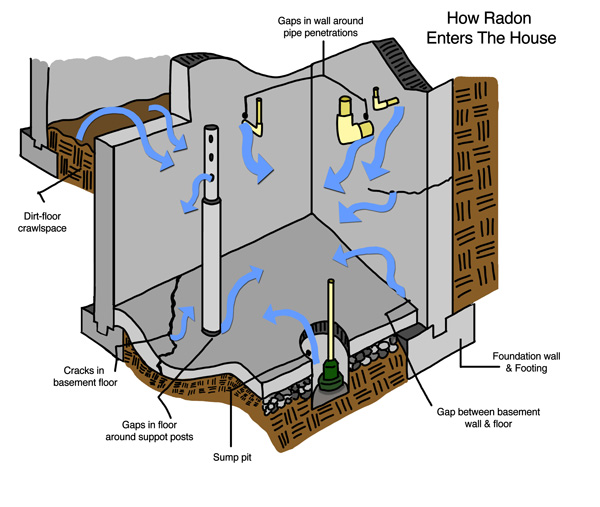
The contractor also recommended installing a small fan and piping into the hole before sealing it off. The fan would gently pull the gas from under the floor slab and vent it outside the house where it would quickly dissipate into the surrounding air. He also recommended a new submersible sump pump with a sealed, radon resistant cover to prevent the gas from seeping in around that. He was very confident that those mitigation measures would bring the average radon concentrations down considerably.
Electronic detector results
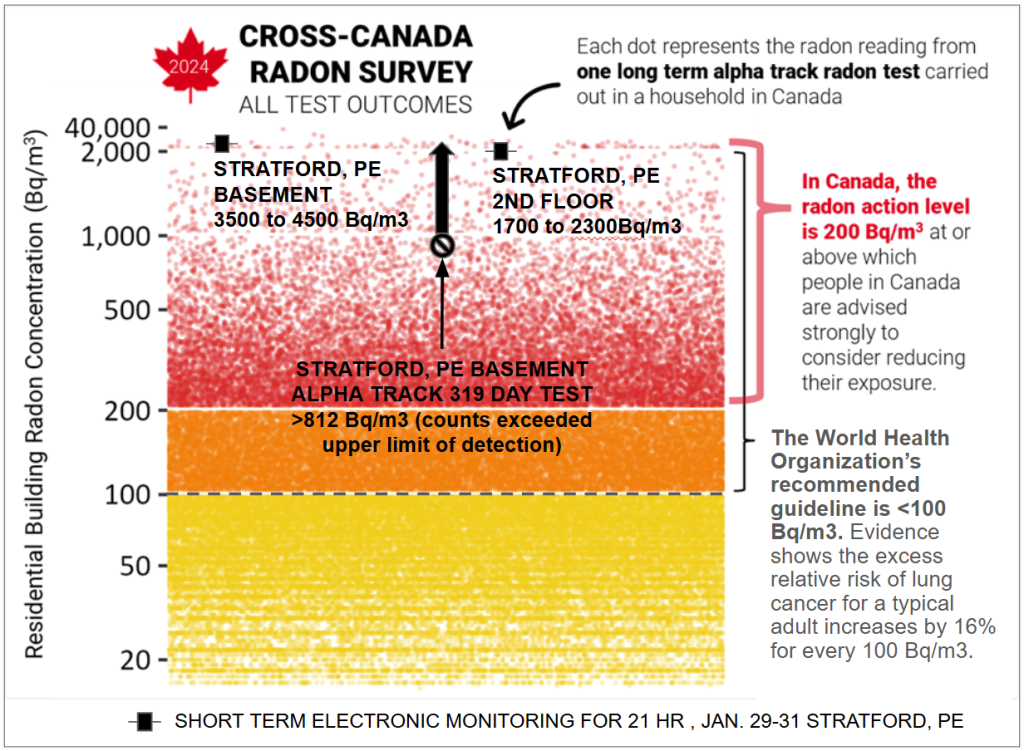
The contractor started the process of ordering the materials needed for the mitigation. In the meantime, we started to get some real-time readings from the electronic detectors. We put one in our son’s bedroom in the basement. After waiting a few hours for it to self-calibrate, we had some results. Over about 24 hours, the levels in my son’s bedroom were measuring in the range of 3300 to 3600 Bq/m3. My heart sank again. That is 18 times the Canadian Guidelines and 36 times the WHO Guidelines!! Levels in the furnace room where the sewer cleanout access hole and sump pump pit were located registered as high as 4500 Bq/m3.
I placed another monitor on the top floor, where most of the bedrooms are. Over 24 hours, the levels were mostly in the range of 1700 to 2000, with a couple of short term peaks of 2300 Bq/m3. That is 10 times the Canadian Guidelines or 20 times the WHO Guidelines.
I plotted our test data on top of a graph presenting the aggregated results of the 2024 Cross-Canada Radon Survey. Our results were among the highest levels observed across the country!
Mitigation measures and post-mitigation radon levels
The contractor ordered the materials needed and completed the mitigation work quickly. The primary mitigation measure was to install an active soil (sub-slab) depressurization (ASD) system. A fancy term for a radon certified fan and some piping. He also upgraded the sump pump, pit and cover to prevent gas from getting in around there and sealed some obvious cracks and gaps in the basement floor.
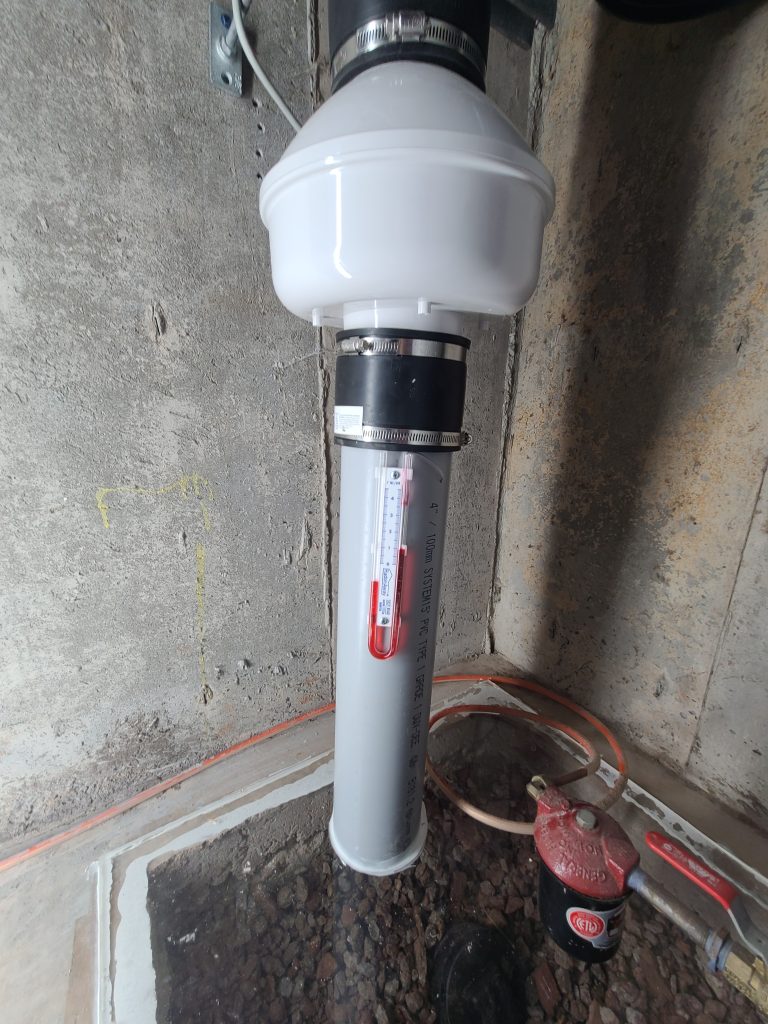
After a couple of days, much to our relief, the radon levels plummeted. We were monitoring levels on all three floors. Average levels on the main floor and 2nd floor are already down where they should be. Levels in the basement dropped considerably, but the short term averages are still slightly above guidelines.
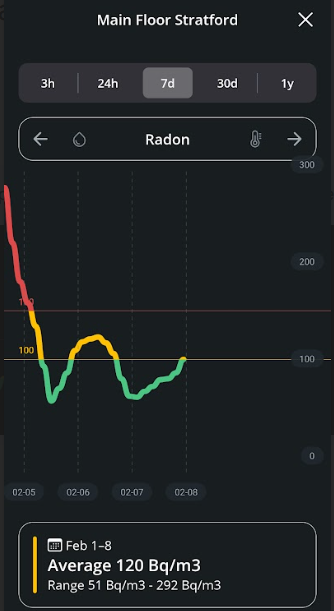
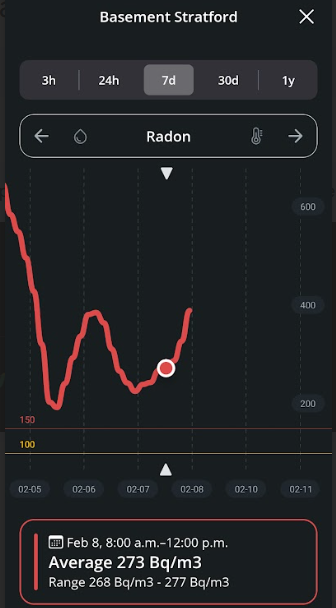
The contractor is in the process of implementing further corrective actions. The gas can flow through very small gaps and cracks in the concrete, so it helps to seal as many of these as possible, especially the ones closest to the radon fan suction point in the floor slab.
In the readily accessible, unfinished areas of the basement, the contractor sealed the joint between the concrete floor slab and the concrete walls with caulking. This is something any handy DIY homeowner could do themselves. They also sealed around some water pipes and in-floor heat pipes where there were some gaps around those pipes. We were relieved to see that every time they sealed off more gaps the average radon levels dropped even further.
There are also some simple adjustments to the air flow dynamics in modern homes that will help prevent radon from coming in. Like most homes less than 30 years old, ours was built with some common energy efficiency features, including an air exchange HRV system. We are going to get it checked to make sure its balanced. If its unbalanced, the differential between the fresh air intake and stale air exhaust could create a negative pressure inside the house which will cause make-up air to be sucked from the ground – where the radon is. Such a simple thing that can be checked and corrected to reduce radon levels!
Understanding the lung cancer risk from our past exposure
Being exposed to radon does not produce any immediate symptoms, but long-term exposure to radon – at any level, but especially at high levels – can cause lung cancer.
The risk of developing lung cancer due to radon is even higher for smokers. It is the leading cause of lung cancer for non-smokers and the second leading cause for smokers.
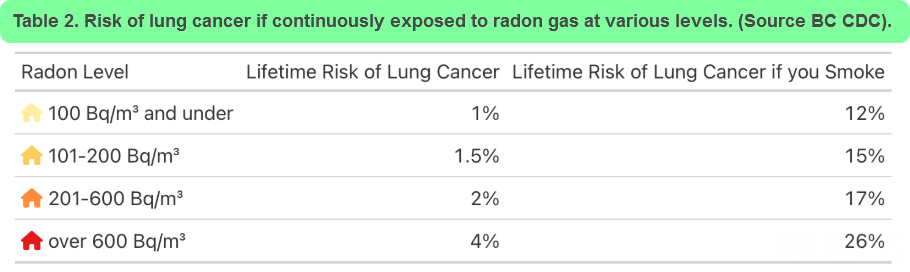
Older “Citizen’s Guide” public awareness material from the USEPA tried to quantify and explain the comparative risk for different levels of radon exposure. While we were exposed to those high levels of radon gas, it was as if we were smoking 3 to 4 packs of cigarettes per day!!!
Table 1 shows comparable risk for different radon levels in terms of smoking cigarettes or how many chest X-rays per year would be required to create a similar risk.
Going forward, residual risk from our (lifetime weighted average) *past* level of exposure is still significant. For the three highest exposed family members it’s comparable to if we continued smoking 2 packs of cigarettes a day for the rest of our lives, or getting 20,000 chest X-rays per year!!
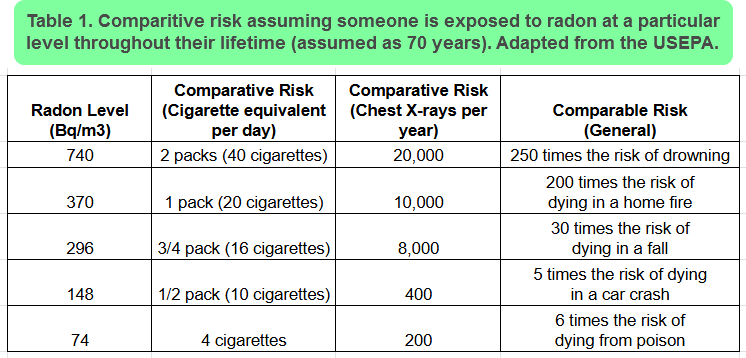
Table 2 (below) is from the BC Centre for Disease Control and shows the estimated lifetime risk of lung cancer if a person is continuously exposed to radon gas. For non-smokers, the risk increases in a linear fashion with increasing radon concentration. North American and European studies have both shown there is a 16% increase in relative lifetime risk of lung cancer for every 100 Bq/m3 of long term radon exposure. For smokers, the additional risk from radon increases substantially.
When estimating risk, there are assumptions made about consistency of the duration of exposure (i.e. that our house has remained the same for many years). Longer term studies show that radon levels naturally flux over time due to things such as weather (temperature, barometric pressure), shifts in soils underground – such as from earthquakes, drilling of wells and other types of drilling, nearby developments, home changes – implementing energy efficiency measures (often increases radon levels), finishing basements, etc. All of these factors could influence actual radon levels over time.
As such, estimates of risk are just that – rough guesses at someone’s exposure. But if we assume that our family have been exposed at these levels for 15 years or more (generally the minimum used in research studies) then our health could be impacted.
What “impacted” means isn’t clear and will need to be followed up with medical professionals in terms of our own health status. Changes in the lungs don’t always lead to cancer. It is a complex cascade of events that occur before cancer actually develops.
The above discussion in italics, was paraphrased from information I received from Dr. Anne-Marie Nicol, an epidemiologist with the BC Centre for Disease Control and Associate Professor with Simon Fraser University. Dr. Nicol is an expert on how radon exposure impacts health and also conducts research related to the public’s perception of risk and risk assessment. She very kindly participated in a web conference call with our entire family so we could ask questions to try to better understand our risk from the exposure and how to help create greater awareness of radon gas in homes and other buildings in PEI.
Where does radon gas come from?
Uranium is the primary natural source of the radioactive decay chain that produces radon gas. It is a common misconception that radon gas problems are only found in provinces with igneous bedrock like granite. Sedimentary sandstone deposits may be the most common source of uranium globally. It’s presence in sedimentary bedrock relies on a process called leaching and precipitation.
As far back as 1968, work by the Geological Survey of Canada in PEI revealed “anomalous radioactivity in many of the greyish-green phases of the redbeds up to four to five times background levels. The highest readings were consistently found in association with greyish green reduction zones, within the redbeds along the base of fluvial channels overlying orange-red very fine grained sandstone and siltstone.” Van de Poll (1983).
Perhaps these old geologic surveys and greenish grey rock layers may provide clues on where unsafe levels of radon gas may be found on PEI. I’m going to try to find others more knowledgeable than me to discuss the possibility with.
How common is radon gas in PEI?
Many people have never even heard of radon gas. From my informal research, it appears that most of those who have heard of it, don’t think its a problem that happens very often, especially in PEI. But according to the 2024 Cross-Canada Radon Survey, 1 in 5 (20%) homes in PEI had test results above the Health Canada guidelines! The percentage which would be above the WHO guidelines would be even higher.
I have learned that high radon levels have been detected in several other areas of Stratford, and that this is a potential problem all over PEI. From my own informal research, unsafe levels have also been recorded in the following areas:
- Tea Hill
- Keppoch Road area
- North Wiltshire
- Hunter River
- Mermaid
- Rice Point
- Canoe Cove
- West River
- Argyle Shore
- Darnley
- Rustico
- Roseneath
- Dunstaffnage
- Blooming Point
- West Royalty
- Winsloe
- Charlottetown
- Summerside
- Alberton
- Mill River
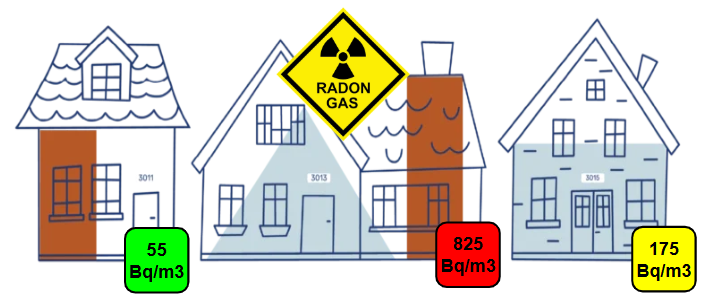
Don’t assume your house is safe just because you don’t live in one of the communities listed above! There simply isn’t enough data yet to predict geographic radon risk on PEI, either because not enough people have tested their homes or they have not shared their test results publicly.
Don’t play “Radon Roulette” with your family’s health
Every home, in every community across PEI should be tested for radon gas. You should test your home regardless of whether your neighbours have high radon levels or not, but especially if they do!
My husband and I are engineers with a science background. We trust science and government agencies like Health Canada. If we had been aware of the potential for high radon levels in PEI… and especially in Stratford…we would have tested our home years ago.
We can’t turn back the clock and reverse the exposure our family has been subjected to. But we have taken steps to evict this unwanted menace from our home and prevent further unnecessary risk to our health. Please test your own home so if you have unsafe levels, you will be able to do the same.
Remember, radon concentrations can vary significantly from house to house—even on the same street—so it’s important to do your own test. Just because your next door neighbour’s house is low or high doesn’t mean your home will be the same. Do your own test for your own peace of mind.
Where to buy testing kits, detectors and other resources
TakeActionOnRadon.ca has lots of information and resources on the problem and prevalence of radon gas in Canada.
Long term (3-month) alpha track, test kits
To get an accurate indication of the radon levels in your home, Health Canada recommends conducting a long term test for a minimum of three months during the heating season, or up to a year. Long term test kits with an Alpha Track dosimeter are a single-use test that measure average radon levels over a period of time. They must be shipped to a laboratory for testing.
Order your own radon test kit online from LUNGNSPEI.ca. They only cost $55 and include testing at a laboratory in NB.
https://www.lungnspei.ca/product-page/radon-detector-kit
You can also purchase long term test kits online from AccuStarCanada.com. They cost $41.95 each and also offer volume discounts for two or more kits. Testing is included but the detectors must be shipped to a lab in the USA.
https://accustarcanada.com/products/at100
In PEI, you can purchase long term radon test kits from Mr. Plumber in Charlottetown. Testing is included but the detectors must be shipped to a lab in the USA.
If you live in New Brunswick, you can pick up an Alpha Track test kit free of charge at any public library. Nice!
Electronic detectors (monitors)
It is highly recommended that you carry out a long term test using one of the Alpha Track dosimeter testing kits mentioned above. However, if you want to get some preliminary test results sooner, this page lists several Health Canada approved electronic radon monitors, as well as ones that are not approved or have been recalled:
https://c-nrpp.ca/consumer-grade-electronic-radon-monitors/
In PEI and NS, you can also borrow an electronic detector for 6 weeks from any public library. However, there are currently only 40 devices available for all of PEI. As of this writing, they were all signed out and there was a waiting list of 100+ names. The librarian I spoke to estimated it could be 6 months before one would become available if someone joined the wait list now. Remember, to get a realistic indication of your exposure levels you need to test during the heating season (typically October to April or possibly May, if you keep the windows tightly closed).
How to find a radon measurement or mitigation professional
If you prefer to have a professional carry out radon testing on your home, or need to mitigate unsafe radon levels, it is recommended to hire a practitioner certified by the Canadian National Radon Proficiency Program (C-NRPP). Their web site provides resources to locate a professional in PEI or the Maritimes.
Share your radon test data (anonymously)
Have you tested your home or are you planning to do a test? Share your radon data anonymously to be included in a national database and aggregated map. You can help make a difference by increasing the amount of information available on radon across Canada. Your data will averaged with other data from your postal code region and displayed in a way that protects privacy. It will also be stored securely by Take Action On Radon and C-NRPP in the radon database. (Note: the map appears to currently be not available, however it is supposed to be back up soon!).
PEI / Maritime radon awareness survey
I have tried to inform as many of my neighbours as possible about our test results and the potential for unsafe levels. Several neighbours have their own testing underway. I have also posted on social media and emailed people in my network to help amplify the message. Please share this article to increase awareness of the potential problem and risks so more people will test their homes for radon and be able to take action if levels are unsafe.
Please complete my short anonymous survey (just 7 questions) about your awareness of radon gas on PEI (or in the Maritimes) and your opinions and intentions around testing. I am also trying to understand why people are motivated or not, to test their homes for radon. I plan to pass any insights I learn on to the provincial government.
If you are an engineer, architect, building contractor, educator or other professional and want to help me raise awareness about the problem of radon gas on PEI, please get in touch through the survey above, or email me at: radonpei@gmail.com
Videos about radon gas in Canada
Segment by CBC News: The National “The cancer-causing gas hiding in millions of homes” (aired Jan. 25, 2026)
Video on how public health practitioners can mitigate the effects of radon in their communities by the National Collaborating Centre for Environmental Health: